

Did you know that 75% of the electricity used to power your household electronics is actually consumed whilst they are sitting in standby mode? It is a frustrating reality for many UK homeowners facing rising electricity prices. You want to invest in energy saving smart home devices to lower your bills, but you probably worry that adding more technology will lead to a cluttered, clunky aesthetic or a complex setup that feels like a chore.
We understand that efficiency shouldn't come at the cost of style or personal well-being. This guide helps you cut through the confusion to find the latest tools that actually deliver a return on investment whilst enhancing your home decor. You will learn how to curate a more sustainable lifestyle and reduce your carbon footprint with the most reliable 2026 technology. We will explore the newest Matter 1.4 compatible gadgets and smart sensors that automate your comfort, ensuring your home works harder for you, not the other way around.
Key Takeaways
- Transform your home into a sanctuary of modern efficiency where sustainability and sophisticated style coexist effortlessly.
- Discover how energy saving smart home devices like intelligent LED lighting can set the perfect mood whilst significantly reducing your electricity usage.
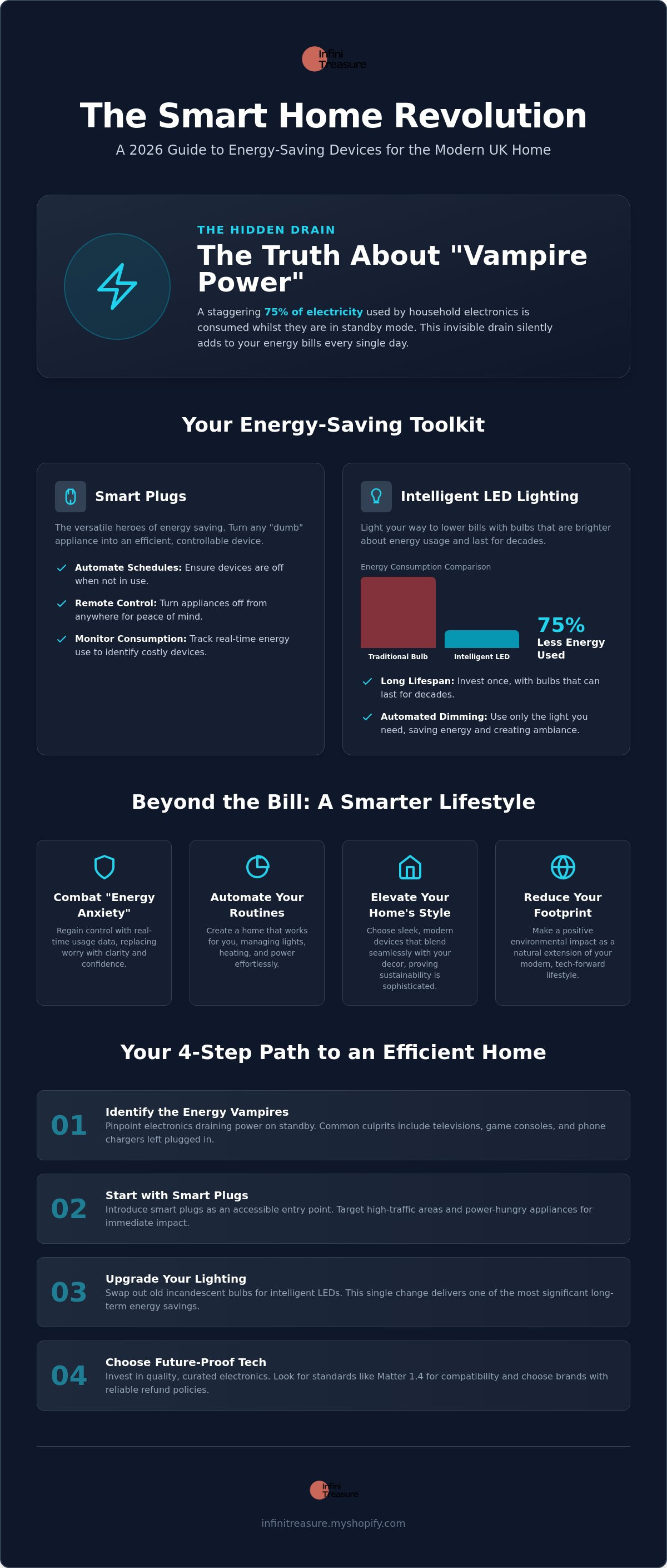
- Uncover the hidden "vampire power" drains in your home and learn practical ways to stop these devices from wasting money on standby.
- Follow a stress-free, step-by-step approach to automating your daily routine, starting with high-traffic areas for immediate impact.
- Gain the confidence to invest in quality electronics by prioritising curated tech that comes with a reliable refund policy for total peace of mind.
The Evolution of the Smart Home: Why Efficiency is the New Luxury
The concept of a connected home has undergone a radical transformation. Only a few years ago, home automation often felt like a futuristic novelty, sometimes more complicated than it was helpful. By 2026, the narrative has shifted entirely. Efficiency is the new luxury. We no longer value tech just for the sake of owning the latest gadget; we value it for the peace of mind and effortless comfort it provides. Today, energy saving smart home devices are essential lifestyle tools for the modern UK household. They represent a sophisticated blend of cost-effectiveness and high-end design that appeals to anyone looking to streamline their daily routine.
The Evolution of the Smart Home shows how we've moved from basic plug-in timers to adaptive ecosystems that actually learn our behaviours. A modern smart home isn't just about saving a few pence here and there. It's about total control. It's the ability to manage your environment from a smartphone, ensuring your space is always perfectly tailored to your needs. This level of integration has become a favourite amongst style-conscious homeowners who prioritise both form and function in equal measure.
Beyond the Bill: The Emotional Appeal of Smart Tech
Living with fluctuating energy prices in the UK has created a specific kind of "energy anxiety." We've all felt that minor dread when a monthly statement arrives. Smart technology replaces that worry with absolute clarity. When you can monitor your usage in real-time, you regain a sense of agency. There is a profound psychological benefit to an organised, energy-efficient living space. It creates a household harmony that's hard to quantify but easy to feel. You don't have to wonder if you left the heating on or if a kitchen appliance is draining power; your home simply tells you. This automation creates a sense of calm, knowing your sanctuary is operating at peak efficiency without any manual effort.
Aspirational Living Meets Sustainable Choices
Modern professionals now view their environmental footprint as an extension of their personal values. Choosing high-quality electronics isn't just a practical decision; it's a lifestyle statement. At Infini Treasure, we curate gadgets that prove you don't have to sacrifice your home's aesthetic for the sake of sustainability. The energy saving smart home devices hitting the market in 2026 are designed to blend into contemporary interiors. They offer a polished, minimalist look that complements your decor rather than clashing with it. It's about being tech-forward whilst remaining deeply rooted in the comfort of your own home. By linking smart choices to a sophisticated lifestyle, you're not just saving money; you're elevating your entire living experience.
Essential Energy-Saving Gadgets: Curating Your Sustainable Space
Building an efficient home doesn't require a total renovation. It's often about selecting a handful of Essential Energy-Saving Gadgets that work together to eliminate waste. These energy saving smart home devices act as the eyes and ears of your household, making tiny, automated adjustments that lead to substantial monthly savings. By focusing on a few key categories, you can transform your living space into a sanctuary that's both technologically advanced and deeply respectful of your budget.
Smart Plugs: The Versatile Heroes of Energy Saving
Smart plugs are the most accessible entry point for any UK homeowner looking to modernise "dumb" appliances. They allow you to set strict schedules for lamps, coffee machines, or heaters, ensuring they aren't drawing power during the night or whilst you're at work. If you've ever left the house wondering if you turned off the hair straighteners, the remote turn-off feature on your smartphone provides instant relief. By tracking real-time kilowatt-hour consumption through a dedicated app, smart plugs reveal exactly which appliances are draining your budget whilst supposedly switched off.
Lighting the Way to Lower Bills
Lighting accounts for a significant portion of home energy use, but switching to intelligent LEDs offers a dual benefit. These bulbs use up to 75% less energy than traditional incandescent options and can last for decades, according to the 2026 Energy-Saving Playbook. Beyond simple efficiency, the ability to dim lights or set schedules ensures you aren't using more brightness than necessary.
- Automated Dimming: Lower brightness levels in the evening to save energy and prepare your body for sleep.
- Presence Detection: Pair your bulbs with smart sensors to ensure lights only stay on when a room is actually occupied.
- Wellness Colours: Adjust the colour temperature from cool morning light to warm sunset hues to support your natural circadian rhythm.
Beyond plugs and lights, smart sensors can trigger actions based on movement or ambient light levels. For example, a sensor can turn off gadgets in a room that has been empty for ten minutes. Energy monitoring hubs then tie everything together, providing a visual dashboard of your home's "heartbeat" so you can spot hidden costs before they escalate. If you're ready to start your journey, you can browse our curated electronics range to find tools that match your home's unique style.
The Invisible Drain: Combatting Vampire Power with Smart Technology
It's a silent drain on your bank account that most people never see. Vampire power, often called phantom load, refers to the electricity your electronics consume whilst they are technically switched off. In the UK, where electricity prices remain a top priority for households, this invisible waste is more than just a minor annoyance. Research from The 2026 Energy-Saving Playbook reveals that a staggering 75% of the electricity used to power household electronics is actually consumed whilst those devices are in standby mode. This means you're likely paying for energy you aren't even using.
The biggest culprits are usually found in our favourite relaxation spots. Your 4K television, the latest games consoles, and even your kitchen microwave are designed to stay in a "ready" state, waiting for a remote signal or keeping a digital clock running. Individually, these devices draw a small amount of power. However, when you add up every "off" device in a standard three-bedroom home, the cumulative cost becomes a significant part of your annual expenditure. Using energy saving smart home devices to manage these loads is the most effective way to reclaim that lost money.
Understanding Standby Consumption in 2026
By 2026, our homes are more connected than ever. This convenience often comes with a hidden price tag as modern electronics prioritise "instant-on" features over deep-sleep modes. To combat this, smart power strips and plugs offer a professional, actionable solution. Beyond the tech, you can adopt simple habits like grouping your home office equipment onto a single smart strip. This allows you to kill the power to your monitor, printer, and speakers with one tap, ensuring your workspace doesn't "leak" energy throughout the night.
Automating the "Off" Switch
Automation takes the effort out of being efficient. You can easily set up "Goodnight" routines that cut power to non-essential zones, such as the living room entertainment centre, at a specific time each evening. Geolocation features can even detect when the last person has left the house, instantly shutting down all energy saving smart home devices that don't need to stay active. This level of control provides immense peace of mind. Automated power-cutting also acts as a protective layer, shielding your expensive electronics from potential power surges by effectively disconnecting them from the live circuit when they aren't in use.
The long-term ROI of smart power management is clear. Whilst there is a small initial investment in the hardware, the savings on your monthly bills often cover the cost of the devices within the first year. It's a savvy, stylish way to protect your finances whilst contributing to a more sustainable UK.
Integrating Smart Devices into Your Daily Routine
Taking control of your energy consumption doesn't have to be an overnight overhaul. It's best approached as a gradual refinement of your lifestyle. By systematically introducing energy saving smart home devices into your daily routine, you ensure that the technology works for you, rather than becoming another task on your to-do list. This methodical approach helps you see immediate results on your energy monitor whilst keeping the setup process stress-free.
- Step 1: Identify your highest energy-use periods. For most UK households, this is the morning rush and the evening wind-down. Check your smart meter data to see where the spikes occur.
- Step 2: Start small. Place one or two smart plugs in high-traffic areas like the kitchen or living room to manage the most active appliances.
- Step 3: Organise your devices into logical "groups" within your favourite app. Grouping by room or function, such as "Downstairs Lights," makes bulk control effortless.
- Step 4: Create simple, helpful automations. A classic example is setting your coffee machine to turn off automatically at 9 am, ensuring it never sits on standby once you've started your workday.
- Step 5: Review your usage data weekly. This allows you to refine your schedules based on your actual habits, ensuring you aren't powering empty rooms or forgotten gadgets.
Organising Your Smart Ecosystem for Ease
Choosing a central hub that feels intuitive is vital for long-term success. With the adoption of the Matter 1.4 protocol in 2026, it's easier than ever to mix and match brands whilst maintaining a unified control centre. Clear naming is also essential; "Reading Lamp" is far easier to control via voice than "Smart Device 402." Integrating these tools with other tech accessories for daily life creates a seamless experience that feels like a natural, stylish part of your home.
Common Pitfalls to Avoid During Setup
Many people worry about the complexity of home automation, but these curated gadgets are designed for a simple DIY setup. Professional installation is rarely needed for the energy saving smart home devices we recommend. The most common hurdle is a weak Wi-Fi signal. Ensure your router is centrally located to reach all your devices, or consider a mesh system for larger homes. Another tip is to avoid over-complicating your routines. Start with one or two helpful actions and only add more once they feel like second nature. If you're looking for reliable tools to begin your journey, you can explore our latest smart electronics collection today.
Shopping for Smart Home Electronics: Quality Meets Convenience
Finding the perfect balance between high-tech utility and home aesthetics can feel like a daunting task. Many online marketplaces are flooded with clunky, outdated gadgets that clash with your decor or, worse, fail to deliver the savings they promise. This is where the power of curation becomes essential. When you select energy saving smart home devices, you aren't just buying a piece of plastic; you're investing in a more streamlined, cost-effective lifestyle. Choosing a partner who has already done the hard work of vetting for quality and style ensures that your home remains a sanctuary rather than a testing ground for unreliable tech.
The "Aesthetic vs. Utility" debate is often a major hurdle for UK homeowners. You shouldn't have to choose between a lower energy bill and a beautiful living room. Modern innovation has finally reached a point where sleek design and high efficiency coexist. By prioritising electronics that offer a polished finish and intuitive interfaces, you can modernise your space without sacrificing the personal style you've worked so hard to create. It's about finding those "smart" essentials that feel like a natural extension of your home rather than an intrusive addition.
The Infini Treasure Difference: Smart Choices Made Simple
We believe that technology should serve your well-being, not complicate it. Our focus is on bridging the gap between high tech and high style, specifically catering to the modern British lifestyle. We understand the unique challenges of UK housing, from managing heating in older builds to finding compact solutions for city flats. Every item in our collection is chosen because it enhances your daily productivity and comfort whilst silently protecting your bank balance. We take the guesswork out of the equation, providing you with a reliable guide to the most effective energy saving smart home devices available in 2026.
Ready to Upgrade Your Lifestyle?
Taking the first step towards a more sustainable home should be an exciting journey, not a risky one. To help you begin your upgrade with total confidence, we offer free shipping on all orders over £50. This makes it easy to bundle a few smart plugs or LED starters to see an immediate impact on your usage. We also provide a 30-day full refund policy for absolute peace of mind. If a device doesn't perfectly fit your routine or your decor, you can return it without any hassle. There has never been a better time to reclaim control over your energy costs and enjoy the effortless harmony of a truly modern home. Start your journey today and discover how simple, stylish, and rewarding an efficient lifestyle can be.
Step Into a More Efficient Future
Modern living is about finding that perfect balance between comfort and conscious choices. You've discovered how simple it is to eliminate vampire power and how effortless automations can transform your daily routine into a seamless experience. Integrating energy saving smart home devices into your life doesn't just lower your monthly bills; it elevates your entire home environment. It's a shift from simply managing a household to enjoying a sanctuary that looks after itself.
We've carefully selected gadgets for the modern British home to ensure you never have to sacrifice style for sustainability. You can shop with confidence knowing we offer a 30-day refund policy and free shipping on all orders over £50. It's time to stop worrying about rising costs and start enjoying the peace of mind that comes with a truly efficient, tech-forward space.
Explore our curated range of smart home electronics and start saving today. Your journey towards a more organised, stylish, and sustainable lifestyle is just a click away.
Frequently Asked Questions
Do smart home devices use a lot of electricity themselves?
No, smart home devices are designed to be incredibly energy-efficient, typically consuming only a few watts of power to stay connected. The release of the Matter 1.4 protocol in late 2025 has further improved efficiency for battery-powered sensors and wireless buttons. The minimal electricity they use is far outweighed by the significant savings they generate by automating larger, power-hungry appliances.
Can smart plugs really save me money on my UK energy bills?
Yes, smart plugs are one of the most effective tools for reducing your monthly expenditure. They work by completely cutting power to electronics that would otherwise sit in standby mode, which accounts for a large portion of wasted energy in the UK. By using a smart plug to manage your home entertainment centre or kitchen gadgets, you ensure you only pay for the electricity you actually use.
How much can I expect to save by using energy saving smart home devices?
Your total savings depend on your household habits, but the data from 2026 is very encouraging. Research shows that smart thermostats can reduce heating costs by 20% to 26% in some UK households. Additionally, switching to smart LED bulbs can slash your lighting energy consumption by up to 75% compared to traditional incandescent bulbs, providing a noticeable return on investment within months.
Do I need a smart hub to use energy-saving gadgets?
Not necessarily, as many modern gadgets connect directly to your home Wi-Fi network. However, many smaller energy saving smart home devices use low-power protocols like Thread or Zigbee to preserve battery life. As of January 2026, many homeowners are opting for a certified Thread 1.4 border router to ensure all their sensors and plugs communicate reliably within a single, stable ecosystem.
Are smart home devices difficult to install in a rented property?
Smart home technology is actually ideal for tenants because most devices are "plug-and-play." You don't need to rewire your home or make permanent changes to the building; you simply plug a smart adapter into an existing socket or replace a standard bulb with a smart LED. When it's time to move, you can pack up your devices and take your energy savings with you to your next home.
What is the best smart home device for a beginner to start with?
A smart plug is widely considered the best entry point for anyone new to home automation. They are affordable, require zero technical installation, and provide immediate insight into your energy usage through a smartphone app. It is a low-risk way to see exactly how much power your favourite appliances are drawing and helps you build the habit of creating simple, money-saving schedules.
Is it safe to leave smart plugs on all the time?
Yes, smart plugs are designed for continuous use and are built to meet strict UK safety standards. Most high-quality models include internal surge protection and overload sensors to keep your home safe. In many cases, they actually improve safety by allowing you to remotely check if you've left a heat-generating appliance on, such as a hair straightener or a coffee machine, and turn it off instantly.
How do smart home devices help reduce my carbon footprint?
These devices help you live more sustainably by eliminating unnecessary energy waste. When you use energy saving smart home devices to automate your lighting and heating, you reduce the total demand on the UK power grid. This lower demand means fewer carbon emissions are produced by power stations, allowing you to maintain a comfortable, modern lifestyle whilst actively protecting the environment.